
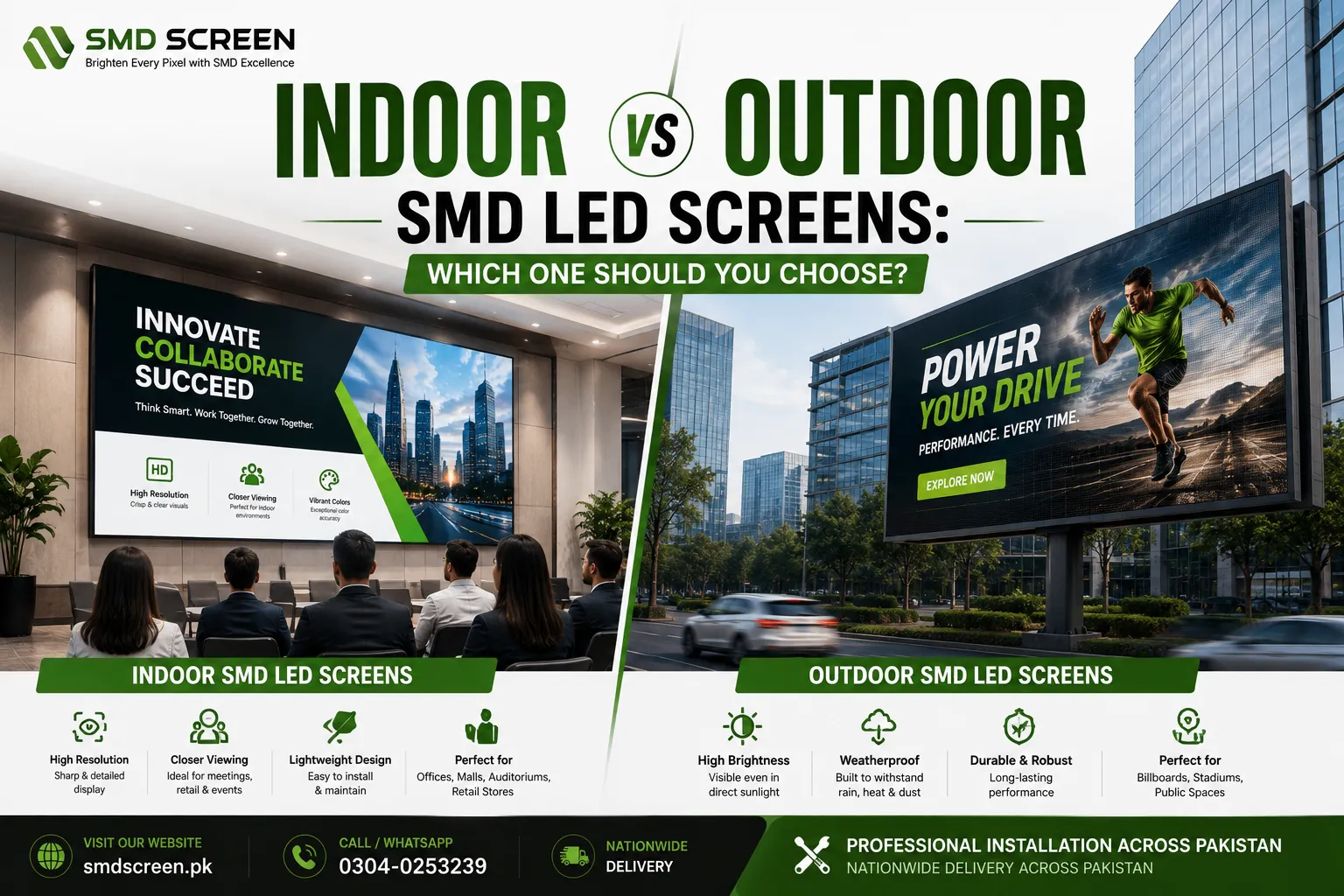
SMD LED screens have become a popular choice for businesses, retailers, event organizers, corporate offices, advertising agencies, and entertainment venues. They provide bright visuals, excellent color reproduction, smooth video playback, and flexible installation options. However, choosing the right LED screen depends heavily on where you plan to install it.
The two main options are indoor SMD LED screens and outdoor SMD LED screens. Although both use Surface-Mounted Device (SMD) LED technology, they are designed for very different environments.
In this guide, we will compare indoor and outdoor SMD LED screens and explain which option is best for your specific application.
What Are SMD LED Screens?
SMD stands for Surface-Mounted Device. In an SMD LED display, red, green, and blue LED chips are integrated into a compact LED package. This technology allows manufacturers to create displays with excellent brightness, color accuracy, wide viewing angles, and high refresh rates.
SMD LED screens are available in different pixel pitches, sizes, brightness levels, and cabinet designs. The right specification depends on viewing distance, installation location, ambient lighting, and the type of content being displayed.
Indoor SMD LED Screens
Indoor SMD LED screens are specifically designed for controlled indoor environments where the display does not need to withstand direct sunlight, rain, dust, or extreme weather conditions.
They generally use lower brightness levels compared with outdoor LED screens because indoor environments have controlled lighting conditions. This helps provide comfortable viewing while maintaining excellent image quality.
Common Applications of Indoor LED Screens
Indoor SMD LED displays are commonly used in:
- Shopping malls
- Retail stores and showrooms
- Corporate offices
- Conference rooms
- Boardrooms
- Hotels and restaurants
- Educational institutions
- Airports and transportation terminals
- Exhibition halls
- Indoor event venues
- Churches and auditoriums
- Entertainment centers
Indoor LED screens are especially useful when viewers are relatively close to the display. For these applications, a smaller pixel pitch such as P1.2, P1.5, P1.8, P2, P2.5, or P3 can provide detailed and sharp visuals.
Outdoor SMD LED Screens
Outdoor SMD LED screens are engineered to operate in demanding outdoor environments. Unlike indoor displays, outdoor LED screens need to remain visible under direct sunlight while also providing protection against environmental conditions.
They typically feature higher brightness, weather-resistant construction, stronger cabinets, and components designed for outdoor use.
Common Applications of Outdoor LED Screens
Outdoor SMD LED screens are commonly installed for:
- Outdoor advertising
- Digital billboards
- Roadside advertising
- Shopping centers
- Building facades
- Petrol stations
- Sports stadiums
- Concerts and festivals
- Outdoor events
- Public information displays
- Commercial plazas
- Large-scale promotional campaigns
For outdoor installations, pixel pitches such as P3, P4, P5, P6, P8, and larger options are commonly selected depending on viewing distance and screen size.
Indoor vs Outdoor SMD LED Screens: Key Differences
The biggest difference between indoor and outdoor LED screens is their ability to operate in different environments.
1. Brightness
Outdoor LED screens require significantly higher brightness because they must remain visible in daylight. Indoor screens use lower brightness because excessive brightness can be uncomfortable in enclosed spaces.
Indoor: Designed for controlled lighting conditions.
Outdoor: Designed for strong ambient light and direct sunlight.
2. Weather Protection
Indoor screens are not designed to handle rain or prolonged exposure to dust and moisture.
Outdoor LED screens are built with weather-resistant protection to help them operate in changing outdoor conditions.
Indoor: Suitable for dry, controlled environments.
Outdoor: Designed for outdoor environmental exposure.
3. Pixel Pitch
Pixel pitch is another important consideration. It refers to the distance between individual pixels.
Indoor displays are often viewed from shorter distances, so smaller pixel pitches are commonly preferred for better detail.
Outdoor displays are generally viewed from farther away, so a larger pixel pitch can provide an effective balance between image quality and cost.
4. Viewing Distance
Your expected viewing distance should play a major role in choosing an LED screen.
For close-up viewing in offices, retail stores, and conference rooms, a fine-pitch indoor LED screen can provide sharper details.
For roadside advertising, building facades, and outdoor events, viewers are usually farther away, making outdoor pixel pitches more practical.
5. Cabinet Construction
Indoor LED cabinets are generally lighter and designed for easier installation in controlled environments.
Outdoor cabinets are typically stronger and designed with additional protection for outdoor operation. Their construction helps protect internal components from environmental conditions.
Which One Should You Choose?
The best choice depends on your installation environment.
Choose an indoor SMD LED screen if your display will be installed inside a building, showroom, office, mall, conference room, hotel, auditorium, or other controlled environment. Indoor screens are ideal when you need high image detail and comfortable viewing at relatively short distances.
Choose an outdoor SMD LED screen if your display will be installed outside and exposed to daylight or changing weather conditions. Outdoor screens are ideal for advertising, digital billboards, building facades, sports venues, roadside locations, and outdoor events.
What About Semi-Outdoor Locations?
Some locations fall between traditional indoor and outdoor environments. For example, a covered entrance, sheltered commercial area, or protected storefront may have different requirements.
In these situations, it is important to evaluate the actual installation conditions rather than choosing a screen simply because the location is partially covered. Factors such as direct sunlight, moisture, ventilation, and viewing distance should be considered before selecting the display.
How to Select the Right Pixel Pitch
Pixel pitch should be selected based on viewing distance, screen size, content requirements, and budget.
For close viewing, a smaller pixel pitch generally provides better image detail. For larger outdoor displays viewed from a greater distance, a larger pixel pitch can be a more practical choice.
For example, a P2.5 indoor screen may be suitable for retail or corporate applications where viewers are relatively close, while a P4 or P5 outdoor screen can be appropriate for larger advertising displays viewed from farther away.
Final Thoughts
Both indoor and outdoor SMD LED screens offer excellent visual performance, but they are designed for different environments. Indoor SMD LED screens focus on fine image detail, comfortable brightness, and close viewing distances, while outdoor SMD LED screens prioritize high brightness, durability, weather resistance, and visibility in daylight.
Before purchasing an LED display, consider the installation location, viewing distance, ambient lighting, required brightness, pixel pitch, screen size, and environmental conditions.
Choosing the right SMD LED screen from the beginning can improve image quality, reliability, operating efficiency, and long-term value. Whether you need a fine-pitch display for a corporate boardroom or a high-brightness screen for outdoor advertising, selecting the correct type ensures your LED display performs effectively for its intended application.